
Business growth mini-course
Keyword Research Course
for Businesses
Learn keyword research through 24 written lessons and exercises. Find buyer-intent searches, prioritize opportunities and map keywords to your pages.
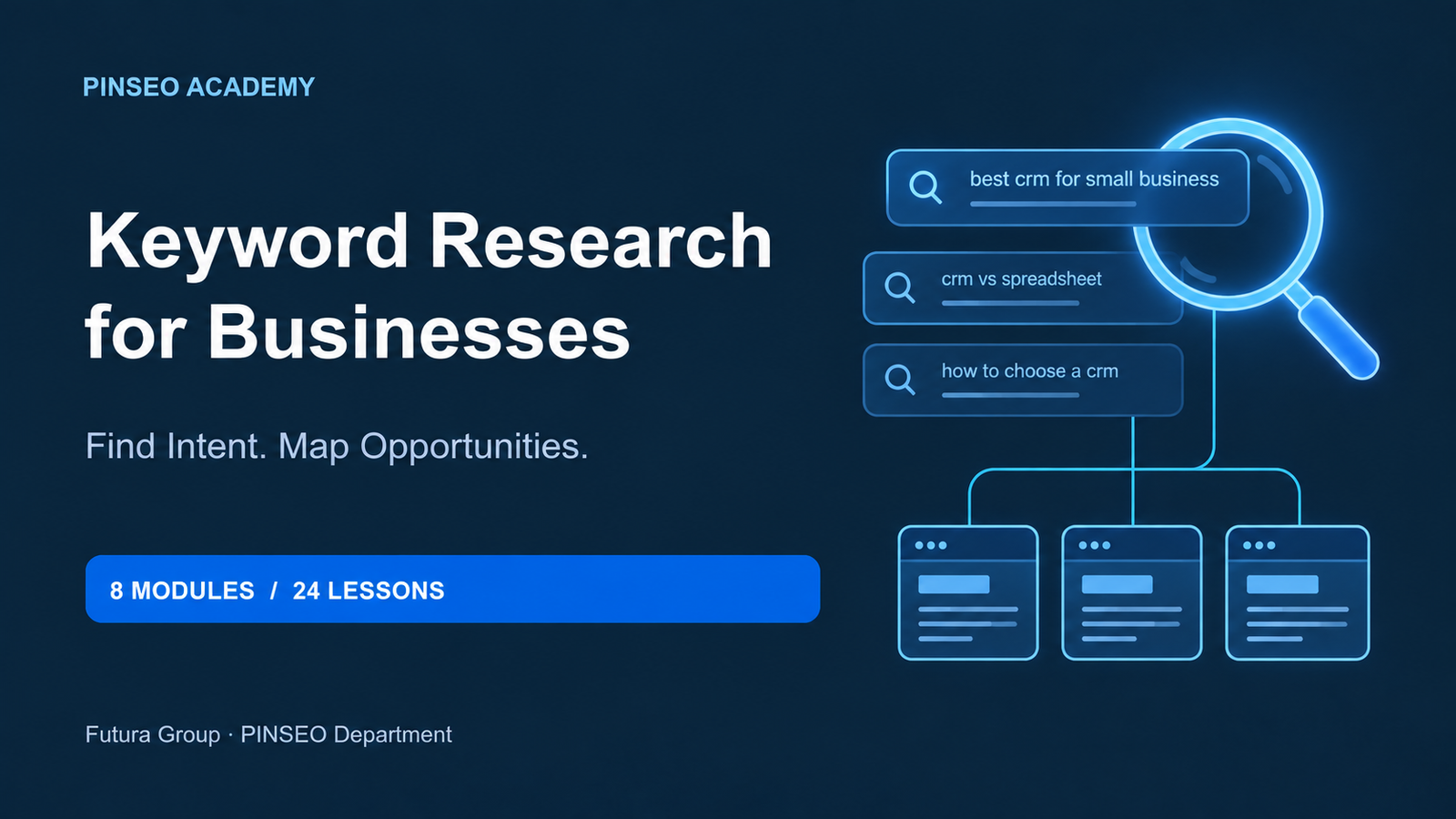
Course overview
Research keywords as business opportunities—not just search volumes.
Learn customer language, search intent and competition, then choose keywords that support your business goals.
By the end, you will have a prioritized keyword opportunity map, a page plan, and a repeatable workflow for future products, services, locations, and content campaigns.
Learning outcomes
What this keyword research course teaches
Move from a long export of keywords to a focused plan your business can act on.
Define useful demand
Translate products, services, audiences, locations, and goals into strong seed topics.
Discover customer language
Find long-tail phrases, questions, modifiers, alternatives, and pain-point searches.
Decode intent
Match each query to the customer journey, page type, offer, and next action.
Evaluate opportunity
Use volume, difficulty, CPC, SERP features, trends, and conversion potential correctly.
Prioritize business value
Score keywords by relevance, commercial value, feasibility, and strategic importance.
Build a page map
Assign keywords to pages and clusters without duplication or cannibalization.
Who this is for
For businesses that want focused organic growth
Ideal for
- Business owners planning their website or content
- Marketing teams choosing SEO priorities
- Freelancers researching for clients
- Local service providers targeting profitable locations
- E-commerce teams organizing categories and products
Prerequisites
- No advanced SEO knowledge required
- A clear product, service, or business idea to research
- Access to search results and a spreadsheet
- Free keyword tools are enough to complete the workflow
- A willingness to prioritize instead of targeting everything
Curriculum
Keyword research course curriculum: 8 modules
Eight modules guide you through discovery, validation, prioritization, mapping, and measurement.
Business goals, audiences, and seed topics
1.1 Connect keyword research to leads, sales, awareness, and retention · 1.2 Define audiences, offers, locations, and differentiators · 1.3 Build a seed-topic inventory from the business itself
Exercise: Complete the business search briefKeyword discovery and customer language
2.1 Expand seeds with search suggestions, questions, forums, reviews, and tools · 2.2 Find long-tail terms and meaningful modifiers · 2.3 Capture problems, comparisons, alternatives, brands, and use cases
Exercise: Build a raw discovery listSearch intent and the customer journey
3.1 Classify informational, commercial, transactional, local, and navigational intent · 3.2 Read the live SERP to verify intent · 3.3 Match queries to awareness, consideration, and decision stages
Exercise: Create an intent and journey matrixMetrics that support better decisions
4.1 Interpret volume, trends, difficulty, CPC, and click potential · 4.2 Separate useful signals from false precision · 4.3 Account for seasonality, zero-click results, and SERP features
Exercise: Validate a 25-keyword shortlistCompetition and business-value scoring
5.1 Evaluate ranking pages, content types, authority, and weak results · 5.2 Score relevance, conversion potential, feasibility, and strategic fit · 5.3 Choose quick wins, core priorities, and long-term targets
Exercise: Build the opportunity scorecardKeyword mapping and topical clusters
6.1 Assign one primary intent to the best-fit page · 6.2 Group supporting terms, questions, and subtopics · 6.3 Prevent cannibalization and plan internal-link relationships
Exercise: Create the keyword-to-page mapLocal, e-commerce, and AI-search opportunities
7.1 Research service-area and local-intent terms · 7.2 Map category, product, attribute, and comparison keywords · 7.3 Identify answer-engine questions, entities, and extractable topics for AI visibility
Exercise: Add one specialist opportunity layerWorkflow, handoff, and measurement
8.1 Clean, tag, prioritize, and document the final dataset · 8.2 Turn research into page briefs and a production roadmap · 8.3 Track impressions, rankings, qualified traffic, leads, and revenue
Final project: Deliver a 90-day keyword opportunity roadmapKeyword research checklist
Before a keyword becomes a priority
Use this quality-control pass to keep your roadmap focused on real business value.
Implementation plan
Your four-week keyword roadmap
Apply the system in focused stages and leave each week with a useful business deliverable.
Define & discover
Complete the business brief, seed inventory, and raw keyword discovery list.
Validate & score
Confirm intent, review metrics and competition, then score the strongest opportunities.
Map & cluster
Assign keywords to pages, organize topic clusters, and resolve overlap.
Brief & measure
Create the 90-day roadmap, prepare briefs, record baselines, and schedule reviews.
Simple one-time pricing
Choose keywords your business can actually use.
A keyword research course for turning search demand into pages, campaigns, and measurable business priorities.
- 8 modules and 24 practical lessons
- Business search brief and discovery workflow
- Intent matrix and opportunity scorecard
- Keyword-to-page mapping checklist
- Final 90-day keyword roadmap
Continue to the course purchase page to review the $49 price and complete checkout.
Frequently asked questions
Questions before you begin
Is this keyword research course suitable for beginners?
Yes. The course explains each metric and decision in plain language, then applies it through a guided business project.
Do I need a paid keyword tool?
No. Free tools and search results are enough to complete the process. Paid platforms can speed up discovery but are optional.
Will this work for local businesses?
Yes. A dedicated lesson covers service areas, local modifiers, location pages, and local search intent.
Does it cover e-commerce research?
Yes. You will learn how to map category, product, attribute, comparison, and problem-based searches.
What will I finish with?
A prioritized opportunity scorecard, keyword-to-page map, topic clusters, and a 90-day production roadmap.
How do I enroll?
Select the enrollment button to review the course purchase page and complete checkout. Use your purchase account to study the written lessons and practical exercises online.
PINSEO Academy · Powered by Futura Group
Turn customer searches into a focused growth plan.
Apply your keyword research course, prioritize confidently, and give every important keyword a clear business purpose.
View enrollment — $49.00Course purchase guide
Is this keyword research course right for you?
For owners, marketers and freelancers planning pages around a product or service. Start with a spreadsheet and search results; paid SEO tools are optional.
Plan new pages, content calendars or overlapping topics. Prioritize relevance, intent and business value alongside search volume and competition.
What your $49 enrollment includes
Your purchase includes eight modules and 24 written lessons, practical exercises, worked examples and answer guidance. You will build a business search brief, an intent matrix, an opportunity scorecard, a keyword-to-page map and a 90-day roadmap. Sign in to the online learning area with the account used for checkout to study the written lessons and practical exercises. These are self-paced materials that you can work through alongside your chosen business project.
Allow 3–4 hours for study, plus market research and your final keyword map. Start with one manageable offer and date your research notes.
A practical keyword research course project
Define your offer, customers, service area and desired enquiry. Use customer language as a research starting point and remove private details.
Review search results to choose the right page type and decide which queries belong on one page.
Score relevance, intent, business value and effort. Label estimates and revisit your priorities as demand changes.
Record each page’s intent, questions, evidence, next step and review date. The course does not guarantee rankings or sales.
How to enroll in the keyword research course
Review the full syllabus and prerequisites, then buy Keyword Research for Businesses for $49 through the course purchase page. Confirm the displayed course name and price before checkout. After purchase, use the course learning area to study the written lessons and practical exercises online. For access questions, use the Futura Group contact page.
If you already have a reliable keyword map and mainly need to improve a page, compare the on-page SEO course. Store teams can continue with ecommerce SEO training for product and category pages. For answer structure and source clarity, compare AI Visibility & AEO. Each is a separate course with its own curriculum and price. Check Google’s SEO Starter Guide for an independent reference while practicing.
PINSEO ACADEMY GUIDES
Make an informed course choice
Explore practical buying guides before choosing your next skill.
Choosing keyword research training
Compare buyer-intent research, page mapping, tools and course costs.
Read the buying guidePINSEO ACADEMY · ECOMMERCE LEARNING
Improve the pages your shoppers land on.
Ecommerce SEO for Sales brings together product and category optimization, accurate product data, buying-path checks and practical measurement. 8 modules · 24 written lessons · workbook and editable worksheets.
Explore the course →Compare before you enroll
Is this the right course for your next task?
Choose this course before creating or expanding pages when you need to decide which searches matter to your business and where each topic belongs.
Move to the on-page SEO course to apply your keyword map to a webpage. Use the ecommerce course when you need a project focused on products and categories.
Compare all PINSEO Academy courses and prices →Students study online after signing in. Course downloads are for administrators only. Get all courses for $24.99/month or $249/year.