
Keyword research training should help you decide which searches deserve a page and which opportunities are worth your effort. For a business, a long keyword export is only a starting point. The useful outcome is a focused map that connects customer intent, your offer and the right type of page.
PINSEO Academy · Futura Group PINSEO Department
This guide is published by PINSEO Academy, which offers the courses discussed below.
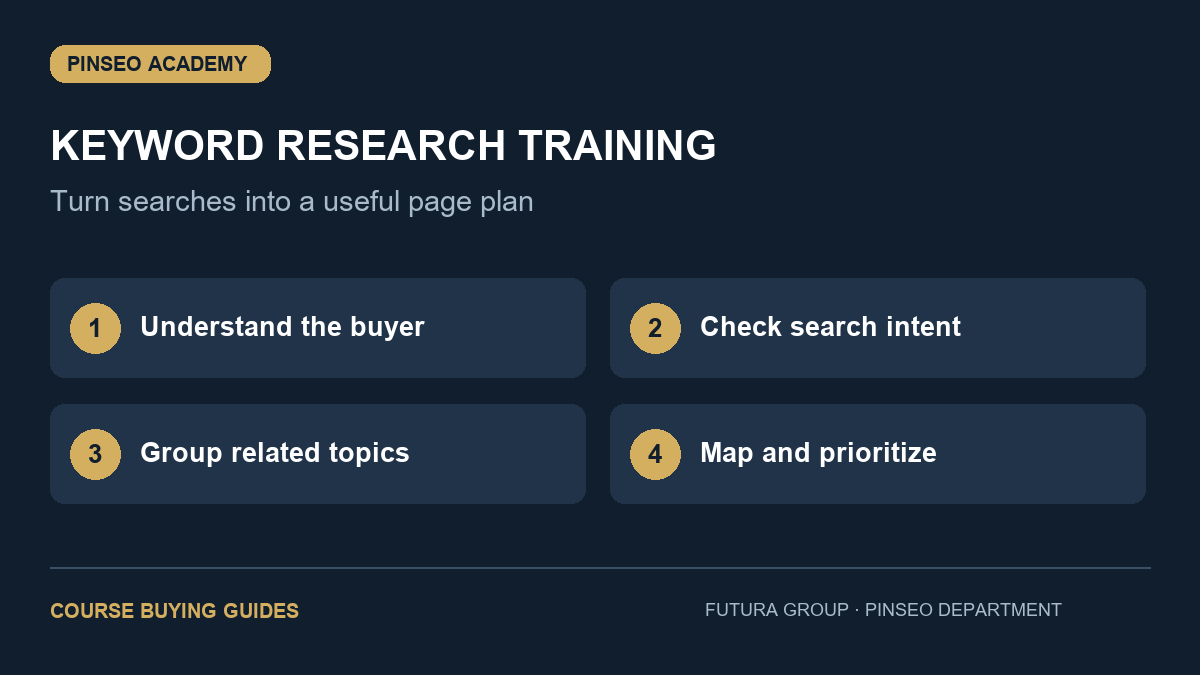
Table of Contents
Start with a business decision, not a keyword total
Before comparing courses, describe what your business sells and the customers you can realistically serve. List a few questions people ask before buying. This gives your research a commercial boundary and helps you avoid chasing popular searches that have little connection to your offer.
Consider a business selling reusable water bottles. “How to clean a bottle” may suit a helpful article, while “insulated water bottle 750ml” may suit a product or category page. Neither phrase is automatically valuable. Relevance, the actual search results and your product range all matter.
A useful course teaches you how to make that distinction and record the reasoning. It should also explain that estimated search volume is a tool’s estimate, rather than a promise of traffic or sales.
7 essential checks for keyword research training
- Customer language. Look for ways to collect topics from real products, customer questions and existing site information.
- Search intent. The course should separate learning, comparison and purchase-oriented searches without assuming every query fits a neat label.
- Search-result inspection. Expect a process for checking the kinds of pages currently shown for a query.
- Business prioritization. Lessons should weigh relevance, capability and likely effort alongside estimated demand.
- Clustering. Related terms should be grouped when they share a purpose, rather than assigned one thin page each.
- Page mapping. The main deliverable should connect topic groups with existing pages or justified new pages.
- Review and refinement. Training should explain how real performance data can improve the map after publication.
These checks distinguish practical keyword research training from a demonstration of a single software interface. Tools change; the reasoning behind a useful page plan remains valuable.
Try this small buyer-intent exercise
Create a worksheet with the columns query, customer need, suitable page, business relevance and next action. Add ten possible searches for one product or service. Inspect the search results and note whether they mainly contain stores, guides, service pages or comparisons.
For the bottle example, a capacity-specific query might map to a suitable range page. A care question could map to an existing guide. A query for a product you do not sell should be excluded or deferred. This is a fictional exercise, not a claim that these particular phrases have verified demand.
Now check for overlap. If three queries express essentially the same shopping need, a single useful page may serve them. If one query asks a different question, document why it may need separate treatment. The goal is a coherent website, not the largest possible number of URLs.
Finish by choosing three priorities you can act on this month. Write the reason for each choice and the evidence you still need. That short decision record is often more useful than hundreds of unreviewed suggestions.
Compare the course fee and tool requirements
PINSEO Academy’s Keyword Research for Businesses contains eight modules, 24 written lessons, practical exercises and a workbook. The published course price is US$49.00; the live curriculum page carries the current offer.
The focus is finding buyer-intent searches, prioritizing opportunities and creating a keyword-to-page map. It is self-paced written training for learners who want to make better content and website decisions.
Before paying for any course, check whether examples require a paid research platform and whether an alternative is available. Course fees and software subscriptions are separate decisions. Do not buy a subscription simply because a screenshot in a lesson uses it.
A business with an existing website may have useful first-party search information, while a new business will have less historical evidence. Good training should help you label uncertainty instead of treating every estimate as equally reliable.
Choose your next step after the keyword map
If your immediate problem is selecting topics and deciding where they belong, keyword research training is the right starting point. Once you have the map, On-Page SEO Blueprint can help you apply it to a webpage. Store owners can compare the ecommerce SEO course for product and category work.
Read our keyword research for business guide for an overview of the workflow. Then compare the curriculum with the deliverable you need: a focused list of page priorities, not just more keyword ideas.
Google’s SEO Starter Guide provides a useful public reference on organizing helpful content. Keep the customer’s task central when turning research into pages.
Frequently asked questions
Is a paid keyword tool compulsory?
Check the curriculum and each exercise before subscribing. A paid tool can provide estimates and research features, but it does not replace judgment about intent, business fit or the quality of a proposed page.
Should every keyword get its own article?
No. Group searches that share a purpose and map them to a suitable useful page. Separate pages need a meaningful difference in intent or content.
Can the course guarantee profitable keywords?
No. Research reduces uncertainty but cannot guarantee demand, rankings or conversions. Use evidence, label estimates and review results after implementation.
Choose your next practical skill
Review the lessons, included resources and current price, then enrol if the course fits your goal.