
About Course
IoT and Smart Automation for Business
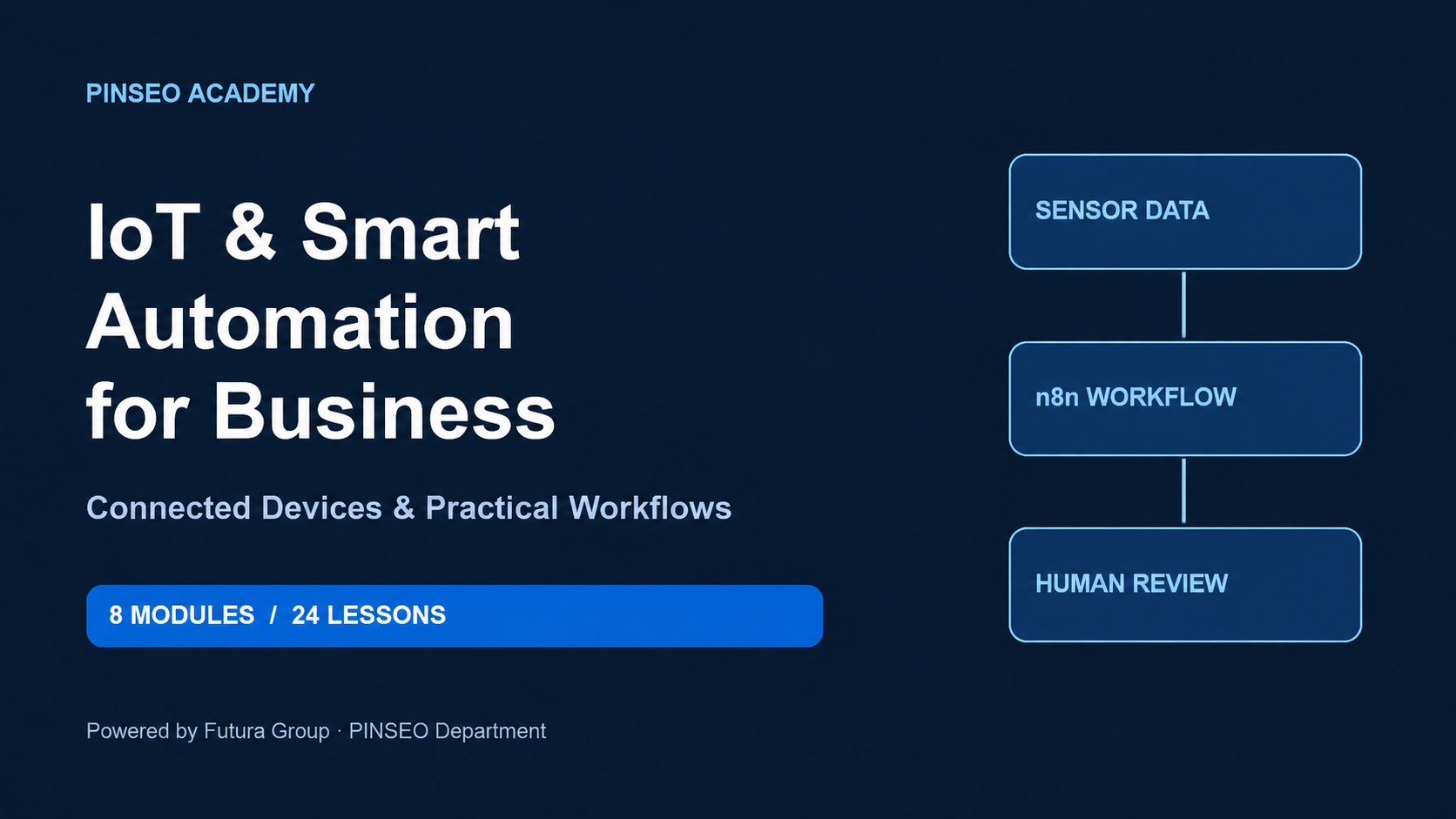
Follow connected-device data from a business question to a useful monitoring prototype. This course introduces sensors, Arduino and ESP32 programming concepts, web interfaces, predictable automation and security planning.
Format: 24 written online lessons across eight modules, with copyable code, guided exercises, planning tables, troubleshooting and self-check answers. Study at your own pace; allow approximately 6–8 weeks for reading, setup and practice.
Course access
US$79 one-time payment for lifetime online access to this course after confirmed payment and account sign-in. The study estimate does not limit access. Existing Academy all-access membership includes published courses while the subscription is active; a standalone purchase does not require an active membership.
What you will learn
- Define a monitoring problem, measure a baseline and scope a practical business pilot.
- Compare sensors and connectivity against data quality, power and operating costs.
- Validate observations, store records once and identify current, stale, faulty and unknown data.
- Build a responsive local dashboard and deterministic alert decisions with human review.
- Plan security, recovery, operating costs and a documented prototype handover.
Practical project and scope
Build a connected local Node.js sender, receiver, durable journal and dashboard using synthetic readings. The local software prototype has been tested. Physical hardware, live TLS/cloud deployment, n8n workflow execution and external AI services require separate validation. The n8n material provides a preparatory workflow scaffold.
Start with a computer, internet access and willingness to practise basic programming. Hardware, hosting, connectivity and optional service fees are separate if you extend the simulation. Monitoring exercises cover low-voltage planning; production deployment requires further engineering and validation.
Who this course is for
Business owners, entrepreneurs, freelancers and learners exploring introductory IoT prototyping. The format is written training; videos, live coaching, personal grading, certificates and supplied hardware are not included. Course completion does not certify production readiness or guarantee business results.
View the full curriculum, requirements and access options · Compare Academy all-access plans
Course Content
Module 1: Introduction to IoT
-
1.1 Choose a monitoring problem and measure the baseline
-
1.2 Map the device-to-decision system
-
1.3 Plan the reference build, parts and safe scope
Module 2: Smart Devices, Sensors & Connectivity
Module 3: Arduino, ESP32 & IoT Programming
Module 4: Connecting Hardware to Web and Mobile Apps
Module 5: AI, n8n & IoT Automation
Module 6: Smart Agriculture, Homes & Businesses
Module 7: IoT Security & Cloud Integration
Module 8: Building a Real-World IoT Project
Student Ratings & Reviews

No Review Yet